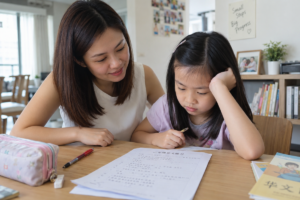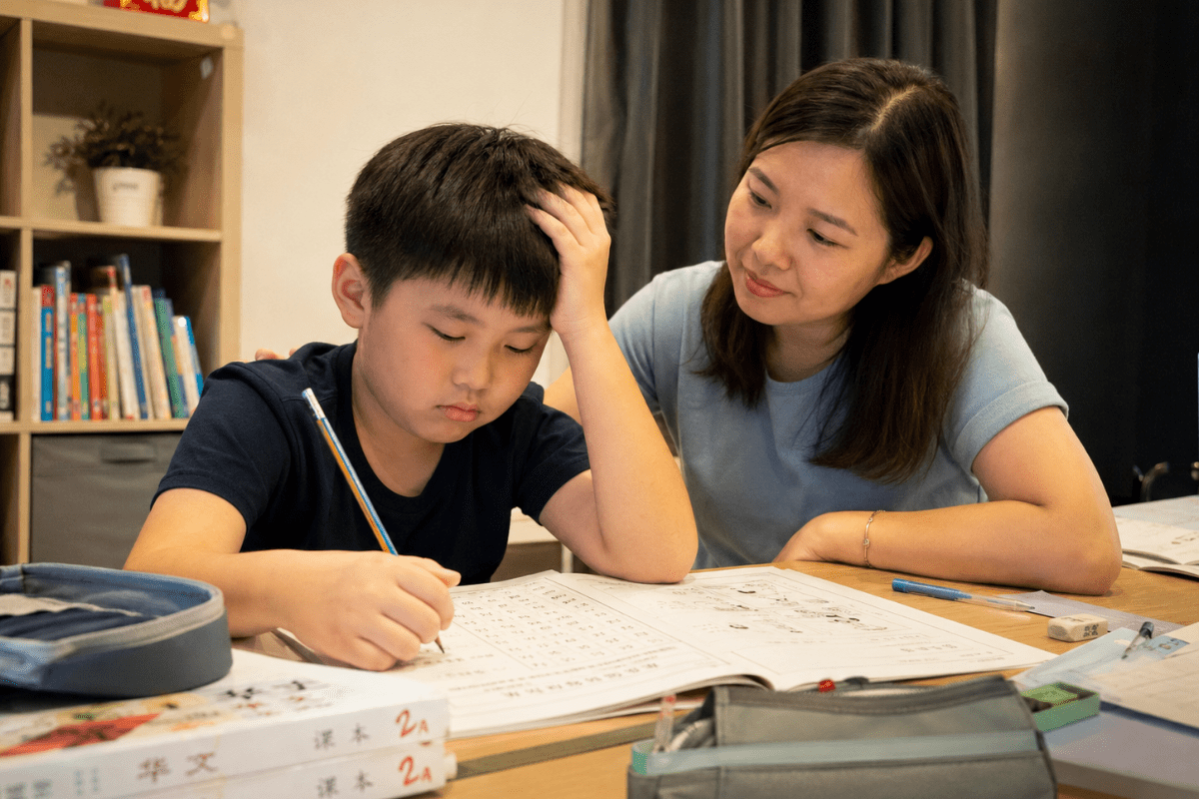
Many parents feel puzzled when their child seems to be working hard for Chinese, but the results still do not improve.
The child attends tuition.
The child completes worksheets.
The child memorises spelling.
The child practises composition phrases.
The child may even do extra assessment books before exams.
But when the paper comes back, the marks are still stuck.
At this point, parents may start wondering:
“Is my child not trying hard enough?”
“Is Chinese just not my child’s strength?”
“Why does my child keep making the same mistakes?”
“How can I help my child improve Chinese?”
Before assuming that the child is lazy or careless, it is worth looking deeper.
Very often, the child is trying.
But the child may not know how to turn effort into marks.
More Practice Does Not Always Mean Better Results
Practice is important. But practice only helps when the child knows what to focus on.
If a child keeps doing comprehension passages but does not know how to identify question types, the same mistakes may continue.
If a child memorises good phrases but does not know how to plan a story, the composition may still feel messy.
If a child reads oral passages again and again but does not correct pronunciation, pauses, or expression, oral practice may not lead to much improvement.
If a child corrects answers by copying the model answer without understanding why their own answer was wrong, the correction becomes copying — not learning.
This is why “do more” is not always the answer.
For many weak or reluctant Chinese learners, the more important question is:
What exactly should my child do differently next time?
The Real Gap: Your Child May Not Know Why They Are Losing Marks
Many students only know whether their answer is right or wrong.
They do not know why they lost marks.
For example, in comprehension, a child may answer:
“因为他很伤心。”
The child may think the answer is correct because it mentions the character’s feeling.
But if the question is asking why the character felt sad, the answer may need to include the cause clearly:
“因为朋友误会了他,所以他感到很伤心。”
The child did not completely fail to understand the passage. The problem is that the answer was incomplete.
This happens very often in Chinese.
Some students know the answer in their head, but cannot express it fully.
Some understand the passage, but miss the keyword in the question.
Some write an answer that is too short.
Some use the correct idea but weak sentence structure.
Some simply copy a sentence from the passage without answering the question directly.
So the real issue may not be “my child cannot do Chinese”.
It may be:
My child does not know exactly what the examiner is looking for.
Common Reasons Chinese Marks Stay Stuck
1. The child memorises without knowing how to apply
Some students memorise spelling, phrases, or model compositions. But during exams, they do not know how to use what they memorised.
For example, a child may memorise a beautiful phrase for composition, but use it in a scene that does not match. Or they may memorise an oral answer, but freeze when the question is asked in a different way.
Memorising can help, but only after the child understands meaning, context, and usage.
A useful question to ask is:
Can my child use this word, phrase, or structure in a new situation?
If not, the child may be memorising more than understanding.
2. The child practises without a clear strategy
Doing many worksheets can look productive. But if the child does not know the strategy behind each section, practice becomes random.
For comprehension, does the child know how to spot question words like 为什么、怎样、从哪里看出?
For composition, does the child know how to plan 起因、经过、结果、感想 before writing?
For oral, does the child know how to give a complete answer with a point, reason, example, and conclusion?
For vocabulary, does the child know how the word is used in a sentence?
Without strategy, the child may be working hard, but not working accurately.
3. The child corrects answers but repeats the same mistakes
Many children do corrections because they are told to.
But not all corrections are useful.
If a child simply copies the correct answer, the brain may not register the mistake clearly. The child may still repeat the same error in the next paper.
A better correction should answer three questions:
- What was wrong?
- Why was it wrong?
- What should I do differently next time?
For example:
Mistake: Answer too short.
Why: I only wrote the feeling, but not the reason.
Next time: For “为什么” questions, I must explain the cause clearly using 因为……所以……
This turns correction into learning.
4. The child has lost confidence
When a child keeps trying but does not see improvement, confidence drops.
They may start saying:
“I’m just bad at Chinese.”
“Chinese is too hard.”
“No matter what I do, I still get it wrong.”
“I don’t want to try anymore.”
This is not just an attitude problem. It may be the result of repeated frustration.
A child who feels lost for too long may protect themselves by avoiding the subject.
That is why small wins matter.
When a child finally understands one question type, improves one oral answer, writes one better paragraph, or avoids one repeated mistake, it sends an important message:
Chinese is not impossible. I can improve.
A Simple 3-Step Review Method Parents Can Use

Parents do not need to be Chinese experts to help their child review more effectively.
After your child receives a test paper or worksheet, try this simple method.
Step 1: Identify the type of mistake
Do not start by asking, “Why are you wrong again?”
Instead, ask:
“What kind of mistake is this?”
Was it:
- Did not understand the question
- Did not understand the passage
- Answer was incomplete
- Sentence structure was wrong
- Used the wrong word
- Did not give an example
- Did not manage time well
- Careless copying from the passage
This helps your child see that not all mistakes are the same.
Step 2: Find the reason behind the mistake
Next, ask:
“Why did this happen?”
For example:
“I missed the keyword.”
“I knew the answer but wrote too little.”
“I copied from the passage but did not answer directly.”
“I did not know how to explain in Chinese.”
“I rushed because I spent too much time in front.”
This step is important because the solution depends on the reason.
If the problem is vocabulary, the child needs vocabulary support.
If the problem is answer structure, the child needs answering technique.
If the problem is confidence, the child needs guided practice and small wins.
Step 3: Write one action for next time
Do not write a long list. Keep it simple.
For example:
- For “为什么” questions, answer with the full reason.
- For oral, give one point, one reason, and one example.
- Before writing composition, plan the story first.
- For vocabulary, make one sentence after learning the word.
- For comprehension, read the question carefully before looking for the answer.
One clear action is better than ten vague reminders.
A Simple Error Log Template
Parents can also help the child keep a small “Chinese mistake log”.
It does not need to be complicated.
|
Question / Section |
My Mistake |
Why I Lost Marks |
What I Will Do Next Time |
|
Comprehension 为什么 question |
Answer too short |
I only wrote the feeling, not the reason |
Use 因为……所以…… and explain the full cause |
|
Composition ending |
Ending too sudden |
I did not write what I learnt |
Add 感想 / 启发 at the end |
|
Oral response |
Answer too simple |
I gave my opinion but no example |
Add one example from school or daily life |
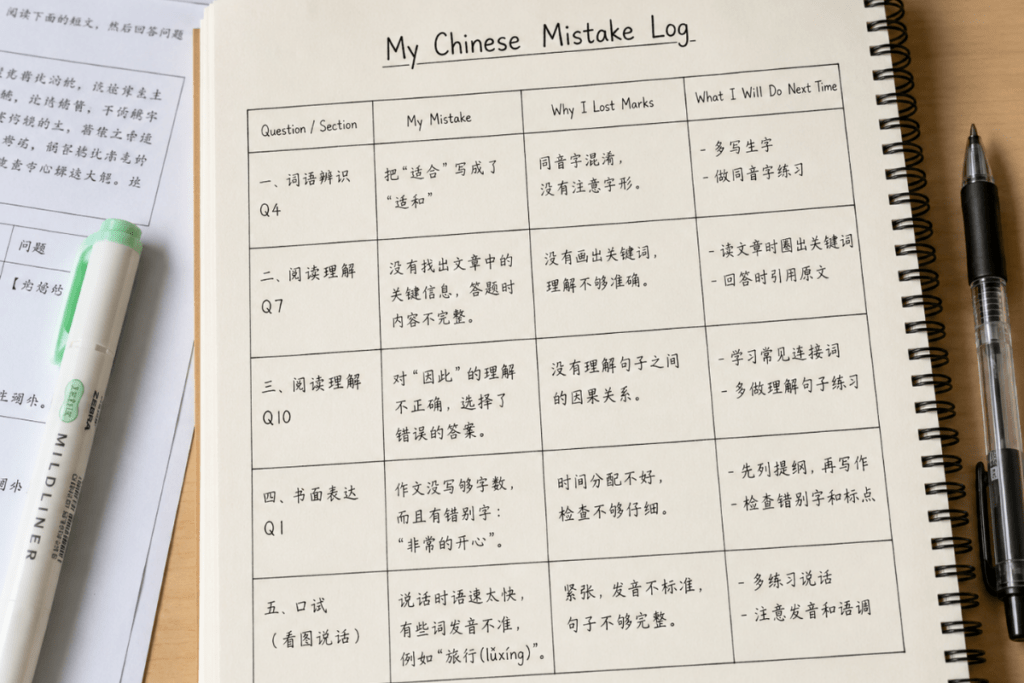
This table helps the child stop seeing mistakes as failure.
Instead, mistakes become clues.
They show the child what to fix next.
What Parents Can Do This Week
Here is a simple action you can try this week.
Take one recent Chinese worksheet or test paper.
Do not review the whole paper at once.
Choose only three mistakes.
For each mistake, ask:
- What type of mistake is this?
- Why did it happen?
- What should be done differently next time?
Write the answers down.
After a few weeks, you may start to notice a pattern.
Maybe your child often gives incomplete answers.
Maybe they misunderstand question words.
Maybe they know the idea but cannot express it in Chinese.
Maybe they do not plan before writing.
Maybe they panic when asked to speak.
Once the pattern is clear, the next step becomes clearer too.
Final Thoughts
If your child works hard for Chinese but still does not improve, do not be too quick to assume that your child is lazy or incapable.
Sometimes, the child is already trying.
But the effort is going in the wrong direction.
To improve Chinese, students need more than practice. They need to understand what went wrong, why it went wrong, and what to do next time.
When students have a clearer method, Chinese becomes less frustrating.
And when Chinese becomes less frustrating, they become more willing to try again.
That is often the first real step towards improvement.
Not sure why your child’s Chinese marks are stuck?
Start by looking at the pattern behind the mistakes.
At Chinese Is Easy, we help students identify their learning gaps, understand why they are losing marks, and build clearer ways to improve.
A useful first step is to review your child’s recent Chinese work and find out whether the issue is understanding, expression, exam technique, or confidence.
FAQ
Why is my child not improving in Chinese despite doing practice?
Your child may be practising without knowing exactly what to correct. Improvement usually requires clear error analysis, understanding of question types, and practical steps to avoid repeating the same mistakes.
Should my child do more Chinese worksheets?
Worksheets are useful, but only when mistakes are reviewed properly. If your child keeps repeating the same errors, it may be better to review fewer practices more deeply instead of doing many worksheets without understanding.
How can I help my child improve Chinese at home?
Start with one recent worksheet or test paper. Pick three mistakes and ask: What type of mistake is this? Why did it happen? What should be done differently next time? This helps your child learn from mistakes instead of only copying corrections.