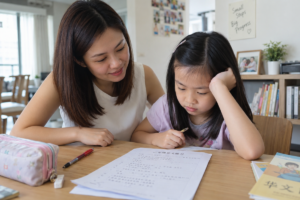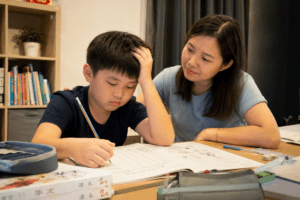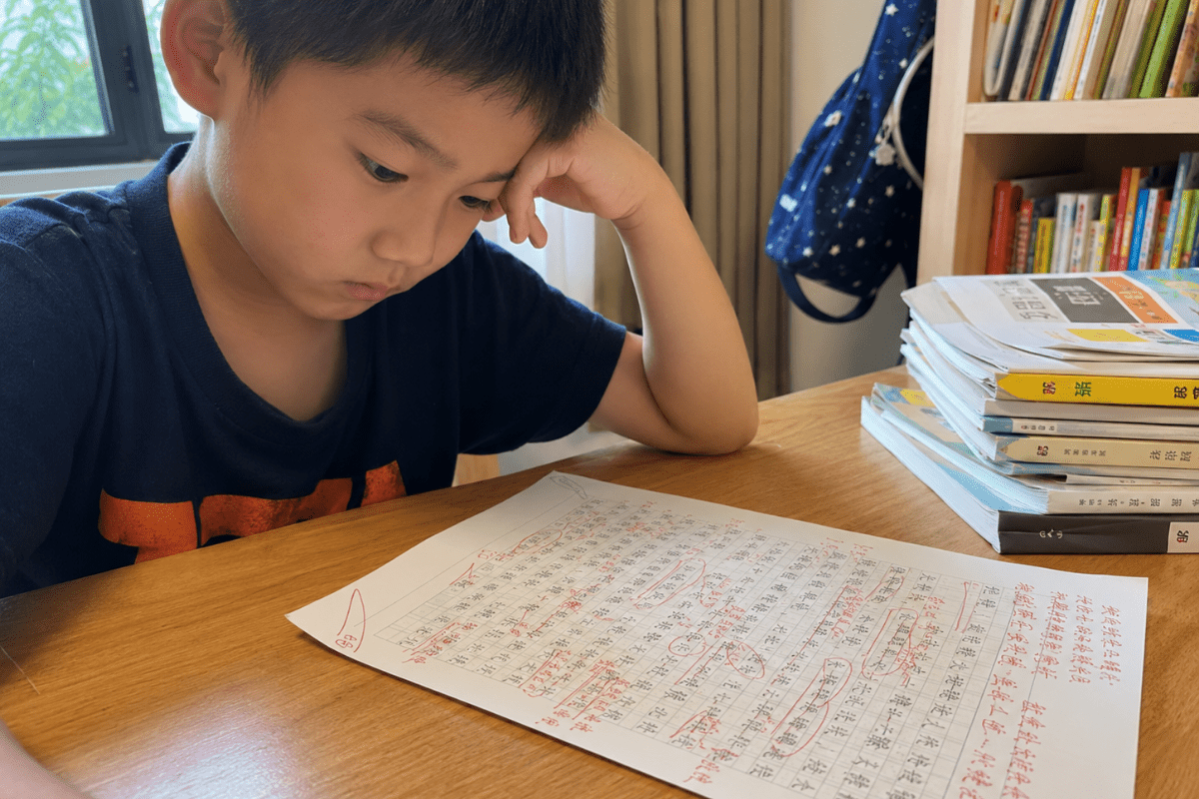
Many parents feel worried when their child struggles with Chinese because the family speaks mostly English at home.
You may hear your child say:
“I know what I want to say, but I don’t know how to say it in Chinese.”
“I understand in English, but I cannot write it in Chinese.”
“I cannot think fast enough during oral.”
“My sentence sounds weird.”
“Chinese is just not for me.”
For many English-speaking or less Mandarin-speaking families in Singapore, this can feel very stressful. Parents want to help, but may not know how to explain Chinese sentence structure, vocabulary usage, composition, oral, or comprehension answers.
Some parents may even wonder:
“If we don’t speak Mandarin at home, can my child still improve in Chinese?”
The answer is yes — but the child may need a different kind of support.
The goal is not to suddenly turn the whole home into a Mandarin-speaking environment overnight. For many children, the first step is simpler:
Help them understand how Chinese works, so they are no longer afraid of using it.
Why English-Speaking Children Often Struggle With Chinese
Many English-speaking children do not struggle because they have no ideas.
Very often, they have the idea in English, but they do not know how to arrange it naturally in Chinese.
This becomes very obvious in composition and oral.
For example, a child may want to say:
“The recess bell rang. Xiao Ming and his friends ate in the canteen.”
But when the child writes in Chinese, it may become:
休息的铃声响了。小明和小明的朋友吃东西在食堂。
The meaning is understandable, but the Chinese expression can be improved.
Let’s look at what went wrong.
Example: When English Thinking Affects Chinese Sentences
1. “小明和小明的朋友” is too repetitive
The child may be translating directly from:
Xiao Ming and Xiao Ming’s friends
But in Chinese, repeating 小明 twice sounds clumsy.
A better way to write it is:
小明和朋友们 or 小明和他的朋友们
This is a small change, but it makes the sentence smoother.
2. “吃东西在食堂” follows English sentence order
The child is thinking in English:
eat in the canteen
So the Chinese sentence becomes: 吃东西在食堂
But in Chinese, the place usually comes before the action: 在食堂吃……
So instead of:
小明和朋友们吃东西在食堂。
A better sentence is:
小明和朋友们在食堂吃饭。or 小明和朋友们到食堂用餐。
This is one of the most common issues for English-speaking students. They may have the correct idea, but they arrange the sentence using English order.
3. “东西” is too general for exam writing
In English, students are used to using “things” very widely.
So they may translate many ideas into 东西:
eat things → 吃东西
buy things → 买东西
take things → 拿东西
put things → 放东西
do things → 做东西
In daily conversation, some of these are acceptable. But in composition and oral, overusing 东西 makes the answer sound vague.
For exam writing, students should learn to be more specific.
Instead of 吃东西, they can write:
吃饭
用餐
吃午餐
买食物
排队买饭
坐在食堂里用餐
So the original sentence:
休息的铃声响了。小明和小明的朋友吃东西在食堂。
can become:
休息的铃声响了,小明和朋友们在食堂吃饭。
Better:
休息的铃声响了,小明和朋友们一起到食堂用餐。
Even better:
休息的铃声一响,小明便和朋友们一起到食堂排队买午餐。
This does not mean the child has no ability. It shows that the child needs guidance in sentence order, word choice, and natural Chinese expression.
Why This Matters for Composition and Oral
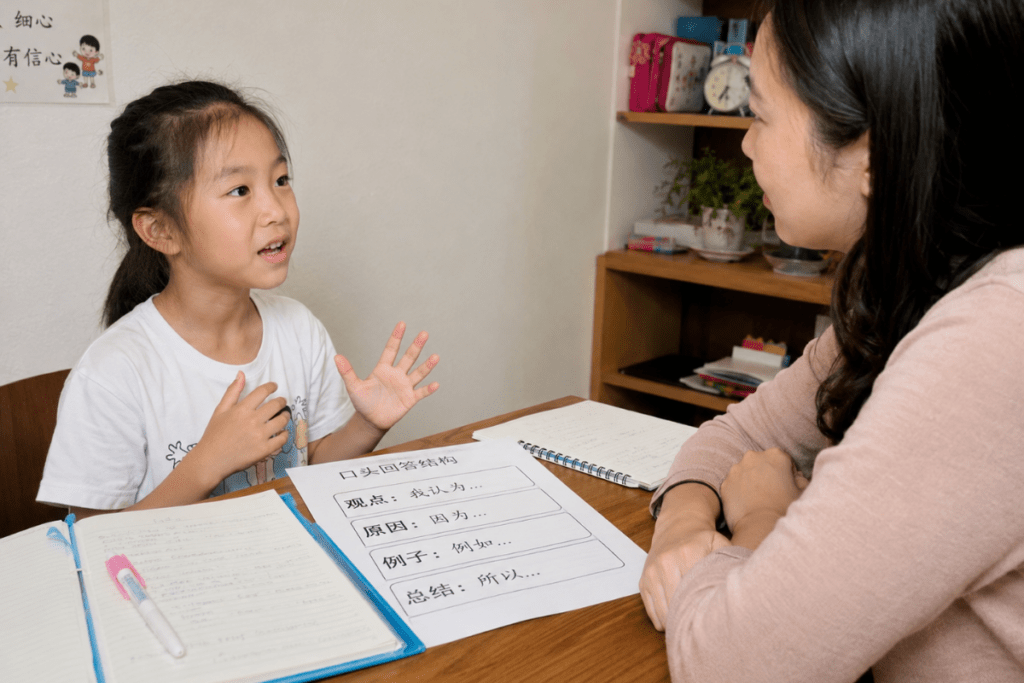
For composition, English-thinking Chinese can make a story sound awkward even when the child has good ideas.
For example, a child may write:
我很开心因为我可以和我的朋友玩。
This is understandable. But a smoother version would be:
我感到非常开心,因为能和朋友们一起玩。
Another child may write:
我做了一个错误。
They are thinking of “I made a mistake.” But in Chinese, we usually say:
我犯了一个错误。
or
我做错了事。
For oral, the same issue appears when students speak.
They may have thoughts, but the answer comes out in short, broken, or translated Chinese. As a result, they may sound less confident even though they know what they want to say.
This is why English-speaking students often need more than vocabulary lists. They need to learn how Chinese sentences are built.
Speaking More Mandarin Helps, But It Is Not the Only Solution
Many parents are told:
“Just speak more Chinese at home.”
This advice is not wrong. More exposure helps.
But for many families, it is not always realistic. Parents may not feel confident in Mandarin. The child may resist. The conversation may become stressful.
Also, speaking more Mandarin does not automatically teach exam skills.
A child may speak some Mandarin casually, but still struggle with:
- composition sentence structure
- oral answer organisation
- comprehension open-ended answers
- vocabulary usage
- formal exam expression
So instead of feeling guilty that your family does not speak enough Mandarin, it may be more useful to focus on building a bridge.
The question is not only:
“How do I expose my child to more Chinese?”
The better question is:
“How do I help my child move from English understanding to Chinese expression?”
A Practical Home Method: Think, Build, Improve
Parents can try this simple method at home.
You do not need to correct everything. Start with one sentence.
Step 1: Think
Ask your child:
“What are you trying to say in English?”
Example:
Xiao Ming and his friends ate in the canteen.
This helps you confirm that the child has the idea.
Step 2: Build
Help the child build the Chinese sentence in parts.
Who?
小明和朋友们
Where?
在食堂
Do what?
吃饭 / 用餐
Put together:
小明和朋友们在食堂吃饭。
This teaches the child that Chinese is not just English words changed into Chinese words. The order matters.
Step 3: Improve
Once the sentence is correct, improve it slightly.
Basic:
小明和朋友们在食堂吃饭。
Better:
休息的铃声响了,小明和朋友们一起到食堂用餐。
Better with more detail:
休息的铃声一响,小明便和朋友们一起到食堂排队买午餐。
Do not ask your child to jump straight from weak sentence to beautiful sentence. Build it step by step.
That is how confidence grows.
What Parents Can Do This Week
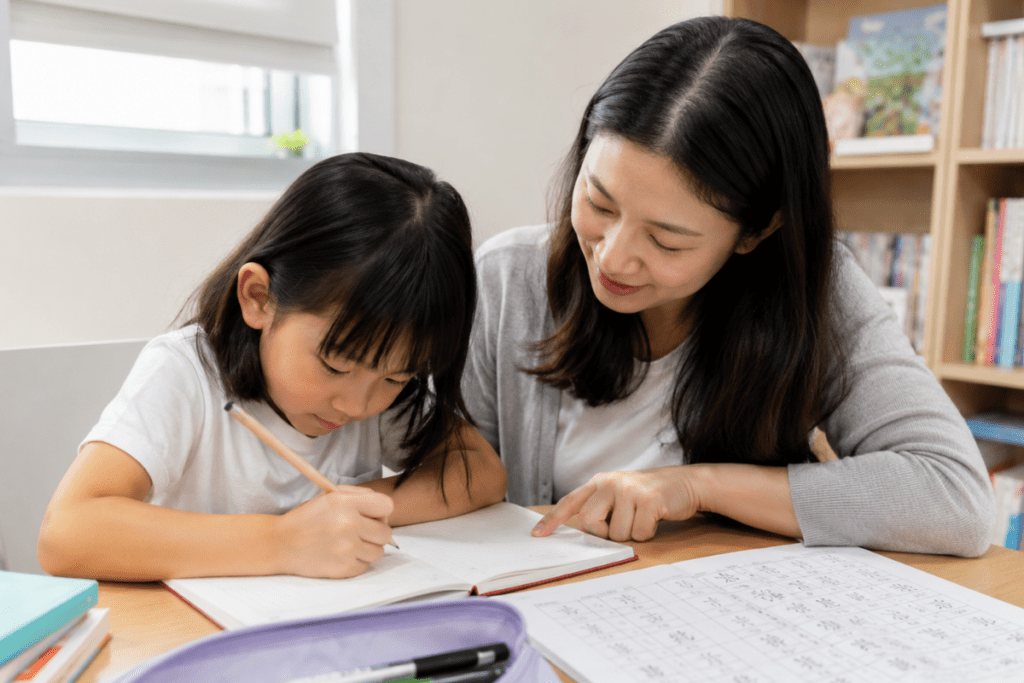
Try this 10-minute activity.
Choose one sentence from your child’s composition or oral practice.
Then ask:
- What is the idea in English?
- Is the Chinese sentence following English order?
- Are there any vague words like 东西, 事情, 做, or 很好?
- Can we replace one vague word with a more specific word?
- Can we improve the sentence without making it too difficult?
Example:
Original sentence:
我做了很多东西。
Ask: What exactly did you do?
Possible improvements:
我完成了老师布置的功课。
我帮妈妈收拾桌子。
我准备了明天要用的课本。
The improvement comes from being specific.
This is a simple habit, but it can help students improve composition, oral, and even comprehension answers.
What Kind of Chinese Tuition Helps English-Speaking Children?
When choosing Chinese tuition for an English-speaking child, parents may want to look for support that does three things.
1. It explains clearly
The child should not leave the lesson feeling even more confused.
For students who already find Chinese difficult, clear explanation is very important. Sometimes, using English to explain the idea first can help the child understand faster before applying it in Chinese.
2. It teaches sentence building, not just memorisation
Memorising good phrases can help, but it is not enough.
Students also need to know:
- where to place the time
- where to place the location
- how to avoid direct translation
- how to replace vague words
- how to make answers more complete
These are practical skills that can be trained.
3. It builds confidence through small wins
A child who dislikes Chinese may not suddenly become confident overnight.
But when they manage to improve one sentence, answer one oral question more clearly, or understand one comprehension mistake, they start to feel:
“Actually, I can do this.”
That feeling matters.
How Chinese Is Easy Supports English-Speaking Learners
At Chinese Is Easy, we work with many students who are weak, reluctant, or more comfortable in English than Chinese.
We use clear explanations and bilingual support where needed, so students can first understand what they are learning, then apply it in Chinese.
This does not mean lowering expectations.
It means helping students access the subject instead of feeling locked out by the language.
For English-speaking children, this bridge is important. Once they understand meaning, sentence order, and exam expectations, Chinese becomes less confusing and more manageable.
Final Thoughts
If your family speaks mostly English at home, your child can still improve in Chinese.
But they may need more than reminders to “speak more Chinese” or “memorise more words”.
They need to learn how to move from English thinking to Chinese expression.
Start small.
One sentence.
One specific word.
One improved answer.
One small win.
When children understand how Chinese works, they become less afraid to try.
And that is often where real improvement begins.
Is your child struggling with Chinese because they are more comfortable in English?
A helpful first step is to find out whether the main gap is vocabulary, sentence order, composition structure, oral confidence, or exam strategy.
At Chinese Is Easy, we help students understand Chinese through clear explanations, bilingual support, and practical guidance, so they can slowly build confidence and apply what they know.
FAQ
Can my child improve in Chinese if we mostly speak English at home?
Yes. Children from English-speaking homes can still improve, but they may need clearer explanations, structured practice, and support in turning English understanding into natural Chinese expression.
Should I force my child to speak Mandarin at home?
Forcing may create resistance if the child already dislikes Chinese. A better starting point may be short, low-pressure Chinese moments, such as improving one sentence or using one useful word correctly.
Is bilingual explanation bad for learning Chinese?
No. For weak or reluctant learners, bilingual explanation can help them understand the concept first. The goal is still to help the child apply the idea in Chinese.
What can I do if my child keeps translating directly from English to Chinese?
Start by improving one sentence at a time. Check whether the sentence follows English order, whether the words are too general, and whether one vague word can be replaced with a more specific Chinese expression.